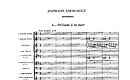
Miroirs
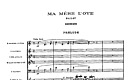
Une barque sur l'océan (orchestral score)
- Cyfansoddwr
- J-M Ravel
- Opws
- Op. 43
- Blwyddyn y cyfansoddwyd
- 1904–5
- Tudalennau
- 43
- Trefnydd
- Maurice Ravel
- Offerynnau
- Cerddorfa
- Trwydded
- Parth cyhoeddus
- Llwythiad gan
- Music Library
- Maint y ffeil
- 1.60 MB
Os ydych yn methu agor y ffeil, bydd rhaid gosod Adobe Reader.
Adolygiadau
Cliciwch i raddio
Dim adolygiadau eto
Adolygiad newydd
Gwybodaeth
Orchestrated by Ravel in 1906.
Gwybodaeth am Miroirs
Miroirs ("Mirrors") is a solo piano work by Maurice Ravel written from 1904–1905.
Ricardo Viñes first performed the work in 1906. Une barque sur l'océan and Alborada del Gracioso were later orchestrated by Ravel. Much of the suite is considered quite difficult, but less so than Gaspard de la nuit. Each movement in this piece was intended to manifest the visual images and ambience evoked when a certain person looked into the mirror (these people are those who received the dedications). With further insight into the piece, it might be surmised that the reflections are revealing parts of Ravel himself being projected onto these separate beings.
Mae'r testun uchod ar gael o dan drwydded y Creative Commons Attribution-ShareAlike License ( creativecommons.org/licenses/by-sa/3.0/ ). Mae'n defnyddio deunydd o erthygl Wicipedia "Miroirs" ( en.wikipedia.org/wiki/Miroirs ).
Ricardo Viñes first performed the work in 1906. Une barque sur l'océan and Alborada del Gracioso were later orchestrated by Ravel. Much of the suite is considered quite difficult, but less so than Gaspard de la nuit. Each movement in this piece was intended to manifest the visual images and ambience evoked when a certain person looked into the mirror (these people are those who received the dedications). With further insight into the piece, it might be surmised that the reflections are revealing parts of Ravel himself being projected onto these separate beings.
- Noctuelles ("Night Moths"), dedicated to Léon-Paul Fargue. This piece begins with highly chromatic pianissimo scampering across the keyboard. The calmer middle section makes use of chordal melodies and a pedal point; this is followed by a return to the introductory material. Curiously, despite the chromatic nature of the work, this recapitulation is a fifth below the first entry.
- Oiseaux tristes ("Sad Birds"), dedicated to Ricardo Viñes. A lone bird sings its sad song at the beginning; other birds reluctantly join in. The wild and raucous middle section is offset by a slow, solemn cadenza, which returns the piece to the solitude and loneliness of the opening.
- Une barque sur l'océan ("A Boat on the Ocean"), dedicated to Paul Sordes (a painter and fellow member of the Apaches). This piece is based around a flowing F# minor/A major arpeggio, with simultaneous melodies in the upper and middle registers. The next section changes key abruptly (to B flat), and a muted climax is followed by a striking passage: a tremolo in the right hand is accompanied by a tremendous G# minor arpeggio in the left hand; when the two meet at fortissimo at the top of the register, they cascade back down the piano. The central section of the piece is based around an ostinato in the extreme upper register containing only the notes F# and A; this forms the accompaniment for a Spanish melody. The accompaniment and melody become more insistent, until a fortississimo climax is reached. The tension slowly gives way, and the opening theme returns, providing the piece with a sense of calm and closure.
- Alborada del gracioso ("The Aubade of the Jester"), dedicated to M. D. Calvocoressi. This piece is heavily influenced by Spanish themes, with the introductory chords reminiscent of guitars. The piece is marked by sharp dynamic and textural contrasts; it contains both stunning melodies and passages of considerable virtuosity.
- La vallée des cloches ("The Valley of the Bells"), dedicated to Maurice Delage. It is believed that the inspiration of the piece lay in the sound of church bells, but it is unknown whether Ravel's "Valley" is Swiss or French. Ravel evokes many different bells throughout this piece; from the delicate bells of the opening to the quietly booming bells of the close. Some of Ravel's most striking melodies occur in this piece, often with lush harmonizations.
Mae'r testun uchod ar gael o dan drwydded y Creative Commons Attribution-ShareAlike License ( creativecommons.org/licenses/by-sa/3.0/ ). Mae'n defnyddio deunydd o erthygl Wicipedia "Miroirs" ( en.wikipedia.org/wiki/Miroirs ).
Trefniannau eraill
-
-
Miroirs
- Cyfansoddwr
- Joseph-Maurice Ravel
- Offerynnau
- Piano
- Opws
- Op. 43
-
Miroirs
-
-
Miroirs
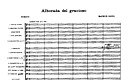
Alborada del gracioso (orchestral score) - Cyfansoddwr
- Joseph-Maurice Ravel
- Offerynnau
- Cerddorfa
- Opws
- Op. 43
-
Miroirs
Prynu argraffiadau printiedig
Rydym ni wedi dewis rhai argraffiadau print a fydd efallai o ddefnydd.
-
- Alborada del gracioso from Miroirs
- Pris
- $7.95
- Offerynnau
- Piano
- Cyhoeddwr
- Alfred Publishing
-
- Miroirs
- Pris
- $7.95
- Offerynnau
- Piano
- Cyhoeddwr
- G. Schirmer
-
- Miroirs
- Pris
- $9.95
- Offerynnau
- Piano
- Cyhoeddwr
- Alfred Publishing
-
- Miroirs
- Pris
- $12.95
- Offerynnau
- Piano
- Cyhoeddwr
- Alfred Publishing
-
- Miroirs
- Pris
- $23.00
- Offerynnau
- Piano
- Cyhoeddwr
- Edition Peters
-
- Miroirs
- Pris
- $32.95
- Offerynnau
- Piano
- Cyhoeddwr
- Editions Durand