Chwyddo

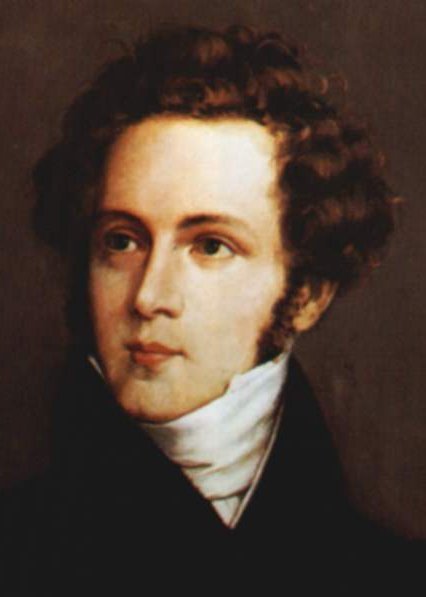
Vincenzo Salvatore Carmelo Francesco Bellini

  • Dyddiadau
  • 3 Tach 1801 - 23 Med 1835

Biwgraffiad

Vincenzo Salvatore Carmelo Francesco Bellini (3 November 1801 – 23 September 1835) was an Italian opera composer. His most famous works are La sonnambula (1831), Norma (1831) and I puritani (1835). Known for his long flowing melodic lines for which he was named "the Swan of Catania", Bellini was the quintessential composer of Bel canto opera.

Life
Born in Catania, Sicily, Bellini was a child prodigy from a highly musical family and legend has it he could sing an aria of Valentino Fioravanti at eighteen months. He began studying music theory at two, the piano at three, and by the age of five could apparently play well. Bellini's first five pieces were composed when he was just six years old. Regardless of the veracity of these claims, it is certain that Bellini grew up in a musical household and that a career as a musician was never in doubt.

Having learned from his grandfather, Bellini left provincial Catania in June 1819 to study at the conservatory in Naples, with a stipend from the municipal government of Catania. By 1822 he was in the class of the director Nicolò Zingarelli, studying the masters of the Neapolitan school and the orchestral works of Haydn and Mozart. It was the custom at the Conservatory to introduce a promising student to the public with a dramatic work: the result was Bellini's first opera Adelson e Salvini an opera semiseria that was presented at the Conservatory's theatre. Bellini's next opera, Bianca e Gernando, met with some success at the Teatro San Carlo, leading to a commission from the impresario Barbaia for an opera at La Scala. Il pirata was a resounding immediate success and began Bellini's faithful and fruitful collaboration with the librettist and poet Felice Romani, and cemented his friendship with his favored tenor Giovanni Battista Rubini, who had sung in Bianca e Gernando.

Bellini spent the next years, 1827–33 in Milan, where all doors were open to him. Sparking controversy in the press for its new style and its restless harmonic shifts into remote keys, La straniera (1828) was even more successful than Il pirata, and allowed Bellini to support himself solely by his opera commissions. The composer showed the taste for social life and the dandyism that Heinrich Heine emphasized in his literary portrait of Bellini (Florentinische Nächte, 1837). Opening a new theatre in Parma, his Zaira (1829) was a failure at the Teatro Ducale, but Venice welcomed I Capuleti e i Montecchi, which was based on the same Italian source as Shakespeare's Romeo and Juliet.

The next five years were triumphant, with major successes with his greatest works, La sonnambula, Norma and I puritani, cut short by Bellini's premature death.

Bellini died in Puteaux, near Paris of acute inflammation of the intestine, and was buried in the cemetery of Père Lachaise, Paris; his remains were removed to the cathedral of Catania in 1876. The Museo Belliniano housed in the Gravina Cruyllas Palace, in Catania, preserves memorabilia and scores.

Works
Bellini's complete works are to be published in Edizione critica delle opere di Vincenzo Bellini, Milan: Ricordi 2003-

Operas

Mae'r testun uchod ar gael o dan drwydded y Creative Commons Attribution-ShareAlike License ( creativecommons.org/licenses/by-sa/3.0/ ). Mae'n defnyddio deunydd o erthygl Wicipedia "Vincenzo Bellini" ( en.wikipedia.org/wiki/Vincenzo_Bellini ).

Enwau eraill

ar:فينشينسو بيليني, be:Вінчэнца Беліні, bg:Винченцо Белини, el:Βιτσέντζο Μπελίνι, fa:وینچنتزو بلینی, ko:빈첸초 벨리니, he:וינצ'נצו בליני, ka:ვინჩენცო ბელინი, la:Vincentius Bellini, ja:ヴィンチェンツォ・ベッリーニ, ru:Беллини, Винченцо, scn:Vicenzu Bellini, sr:Винченцо Белини, uk:Белліні Вінченцо, zh:文琴佐·贝利尼

You may also find sheet music by Bellini on Sheet Music Plus.